North Carolina Recording Laws: One-Party Consent Explained (2026)

When it comes to recording conversations in North Carolina, the law is refreshingly straightforward. From my experience helping people navigate this, the most important thing to know is that as long as you are part of the conversation, you can legally record it.
This is because North Carolina is a one-party consent state. This means your own participation is all the permission you need to record phone calls, in-person discussions, or meetings you're involved in.
Is It Legal to Record a Conversation in North Carolina? The One-Party Consent Rule

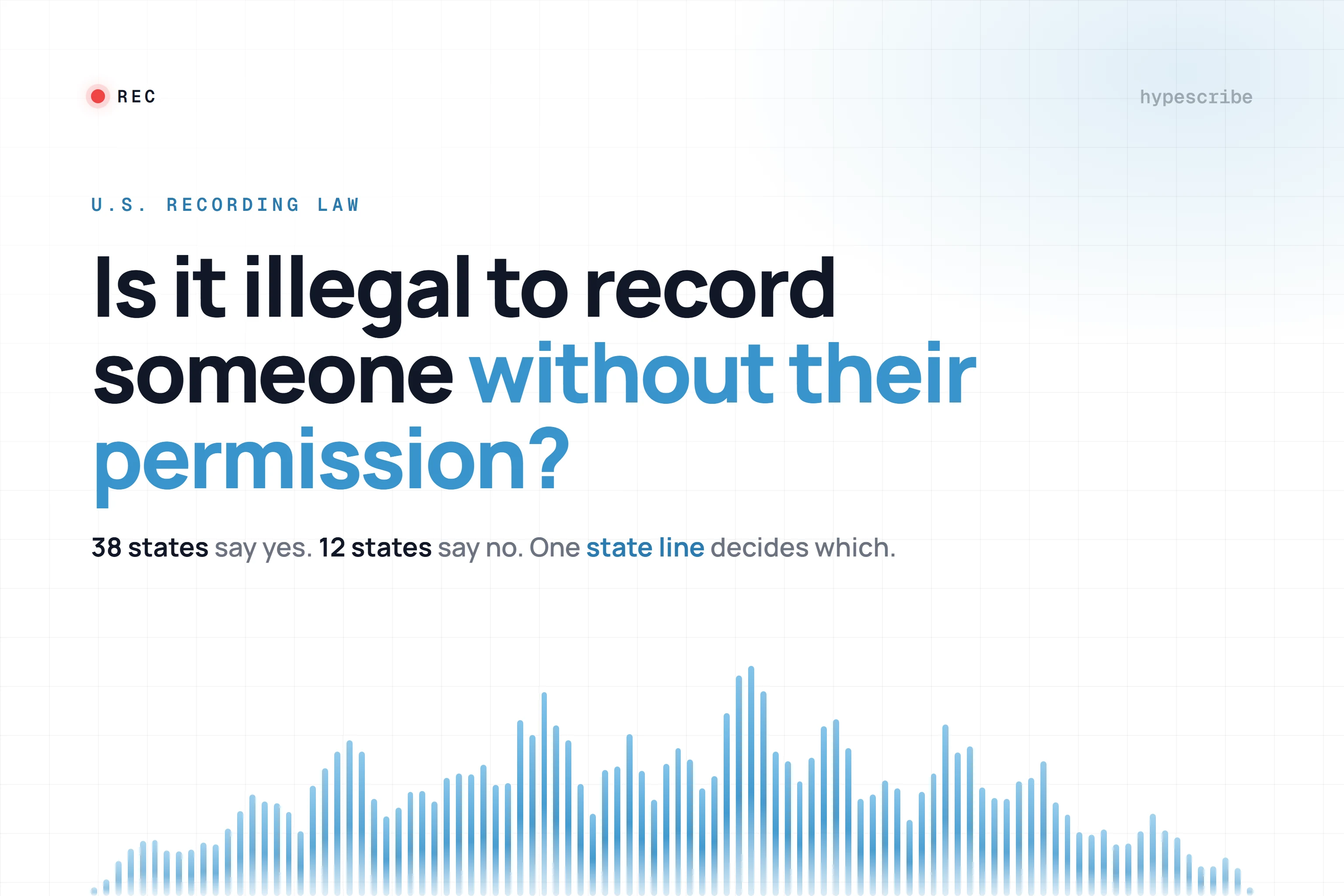
This single principle—one-party consent—is the key to legally recording audio in North Carolina. It puts the Tar Heel State in line with the majority of the country, as roughly 38 other states operate under a similar model.
This is a world away from "all-party consent" states like Florida or California, where you need a "yes" from every single person on the line before you can hit record. North Carolina’s approach simplifies things: if you’re in the conversation, you’re good to go.
To help you keep these key rules straight, here’s a quick summary.
North Carolina Recording Laws at a Glance
This table gives you a high-level view, but understanding the statute behind it is crucial for staying compliant.
The Law Behind the Rule
The legal foundation for this practice is North Carolina General Statute § 15A-287. This is the statute that defines the rules of the road for audio recording in the state. It explicitly permits recording communications as long as you are a party to that communication or have received prior consent from at least one party.
But don't let the simplicity fool you; the stakes are high. The same law makes it a Class H felony to illegally record or disclose a private conversation. For a deeper dive into the legal text and its interpretations, you can find valuable insights on North Carolina recording statutes from legal professionals.
This distinction is what gives you the power to document a crucial call with a vendor, save a verbal agreement, or capture meeting details for a colleague who couldn't be there—all without having to announce you're recording.
My experience shows that the logic is simple: you can't be accused of "eavesdropping" on a conversation you're actively participating in. Your presence is the consent.
What This Means in Practice
While the one-party consent rule is your North Star, we'll see that things can get a bit more complex depending on the circumstances. For now, just lock in these core takeaways:
- You are the "one party": As a participant, your decision to record is all the legal justification you need.
- No duty to inform: You aren't legally required to tell the other people in the conversation that you are recording.
- Broad application: The rule applies to in-person chats, phone calls, and virtual meetings, assuming all parties are in North Carolina.
With this foundational knowledge, you're ready to tackle the trickier situations. Understanding the "what" (one-party consent) sets us up to explore the "how" and "when" of applying this rule correctly and confidently.
What One-Party Consent Really Means in Practice

On the surface, North Carolina’s one-party consent rule sounds straightforward. But putting it into practice correctly hinges on two key ideas: what counts as "consent" and what qualifies as a "private communication." Getting either of these wrong can turn a perfectly legal recording into a felony.
Let's start with consent. It’s not always about getting a formal, "Yes, I agree to be recorded." In many cases, consent is simply implied.
From my experience, a common example is joining a webinar. The host kicks things off by saying, "Just a heads-up, we're recording this session for our library," and you decide to stay. By not leaving, you've given your implied consent. You were clearly notified and made a choice to remain.
Defining Consent: Explicit vs. Implied
Grasping this difference is fundamental for staying on the right side of North Carolina recording laws. Even though you, as a participant, automatically give your own consent, understanding how others’ consent works adds a layer of professionalism and legal protection.
Explicit Consent: This is the gold standard—a direct and clear "yes." It's when you ask, "Is it okay if I record our call?" and the other person agrees. For sensitive conversations, this is always the safest path.
Implied Consent: This is consent you can reasonably infer from someone's actions (or lack thereof) after they've been notified. When an automated phone menu says, "This call may be recorded for quality assurance," and you stay on the line, you're giving implied consent.
Even though North Carolina law lets you record as long as you're part of the conversation, I've found that announcing it is just good practice. It builds trust and avoids awkward situations down the road if the recording comes to light.
The "Reasonable Expectation of Privacy"
The second piece of the puzzle—and frankly, the more nuanced one—is the reasonable expectation of privacy. The law is written to protect private conversations, not anything said out in the open. This is where the specific context of a situation is everything.
Consider two scenarios. In one, a pair of managers are in a closed-door office, discussing sensitive company financials in hushed tones. In the other, the same two managers are having the exact same conversation, just as loudly, in the middle of a packed food court.
Legally speaking, the office meeting has a high expectation of privacy. The managers took deliberate steps—closing the door—to keep their discussion private. Recording that conversation without being part of it would be illegal.
The food court chat, on the other hand, comes with no reasonable expectation of privacy. It's a public space where anyone could listen in. In that setting, North Carolina’s wiretapping statute probably wouldn’t apply because the communication isn't private in the first place.
Knowing this distinction is vital. If people are somewhere they can’t reasonably expect privacy—a public park, a busy store, or a hotel lobby—the rules around recording are far more flexible. To dig deeper into this idea, you can learn more about whether it is legal to record a conversation without consent in our comprehensive guide.
The Steep Price of Getting It Wrong
Making a mistake here isn't like getting a slap on the wrist. Violating North Carolina’s wiretapping statute is a serious crime with penalties that can follow you for life. The law doesn't treat illegal recording as a minor issue; it classifies it as a felony.
The consequences break down into two main areas:
Criminal Penalties: If you illegally record, intercept, or share the contents of a private conversation, you could be charged with a Class H felony. This carries the risk of serious jail time and a permanent criminal record.
Civil Liability: Beyond criminal charges, the person you illegally recorded can sue you. State law allows them to seek financial compensation for actual damages, punitive damages, and the cost of their attorney's fees. The total can add up quickly.
These harsh penalties really drive home how important it is to understand and respect the boundaries of the North Carolina recording laws. Before you hit that record button, always think about consent and whether there's an expectation of privacy.
Navigating Real-World Recording Scenarios in NC
Knowing the theory behind North Carolina's one-party consent rule is one thing, but how does it actually play out in real life? The law really comes into focus when you apply it to the situations you run into every day. Let’s break down some common recording scenarios to give you practical, clear-cut answers.
We'll tackle the specific questions people always ask—about recording calls, workplace conversations, and public events. For each one, we’ll look at it from two critical angles: the one-party consent rule and the “reasonable expectation of privacy.”
Can I Record Phone Calls with Companies?
Yes, for the most part, you can legally record a phone call with a customer service agent from your bank, utility provider, or any other business. Since you are part of the conversation, your own participation satisfies the one-party consent requirement under North Carolina recording laws.
You typically don't even have to tell the representative you're recording. Think about it—how many times have you heard, "This call may be recorded for quality assurance"? That announcement is their notice to you, and by staying on the line, you're giving implied consent. The same principle works in reverse.
But here’s a crucial catch I've seen trip people up. If that call center or agent is based in an all-party consent state like California or Florida, their stricter law usually takes precedence. To play it safe in those cross-state situations, it's always a smart move to announce that you’re recording, too.
Is It Legal to Record My Manager or Coworkers?
This is where things get a bit more complicated. While state law says you can record a conversation you're in—like a performance review with your boss or a team project meeting—your company's own rules can add another layer to the situation.
Many businesses have policies in their employee handbooks that flat-out prohibit secret recordings. Breaking that rule might not be a crime, but it could absolutely get you disciplined or even fired. Before you hit record on any work-related discussion, always check your company’s internal guidelines first.
Key Takeaway: An action can be legal under state law but still be against company policy. Your right to record under N.C. Gen. Stat. § 15A-287 doesn't give you a free pass to violate workplace rules, and it won't protect you from being terminated.
Understanding how these consent laws apply is crucial when navigating real-world recording scenarios, particularly in sensitive family law cases where recordings can have significant legal implications.
Recording Meetings and Public Gatherings
What about recording something like a city council session, a public university lecture, or a community board meeting? In these kinds of settings, the "reasonable expectation of privacy" becomes your north star.
Public Meetings: For events that are open to the public, like a town hall, there's practically no expectation of privacy. Speakers know their words are meant for public ears, which generally makes recording permissible.
University Lectures: Recording a professor's lecture for your own study notes is usually fine, as it's a semi-public, educational setting. Still, some instructors or universities have specific rules against it, so the best policy is simply to ask.
Private vs. Public Events: The game changes if the event is private. A closed-door homeowners' association meeting or a members-only club gathering has a much higher expectation of privacy, making it risky to record without the organizer's explicit permission.
Using Technology for Recording Business Meetings
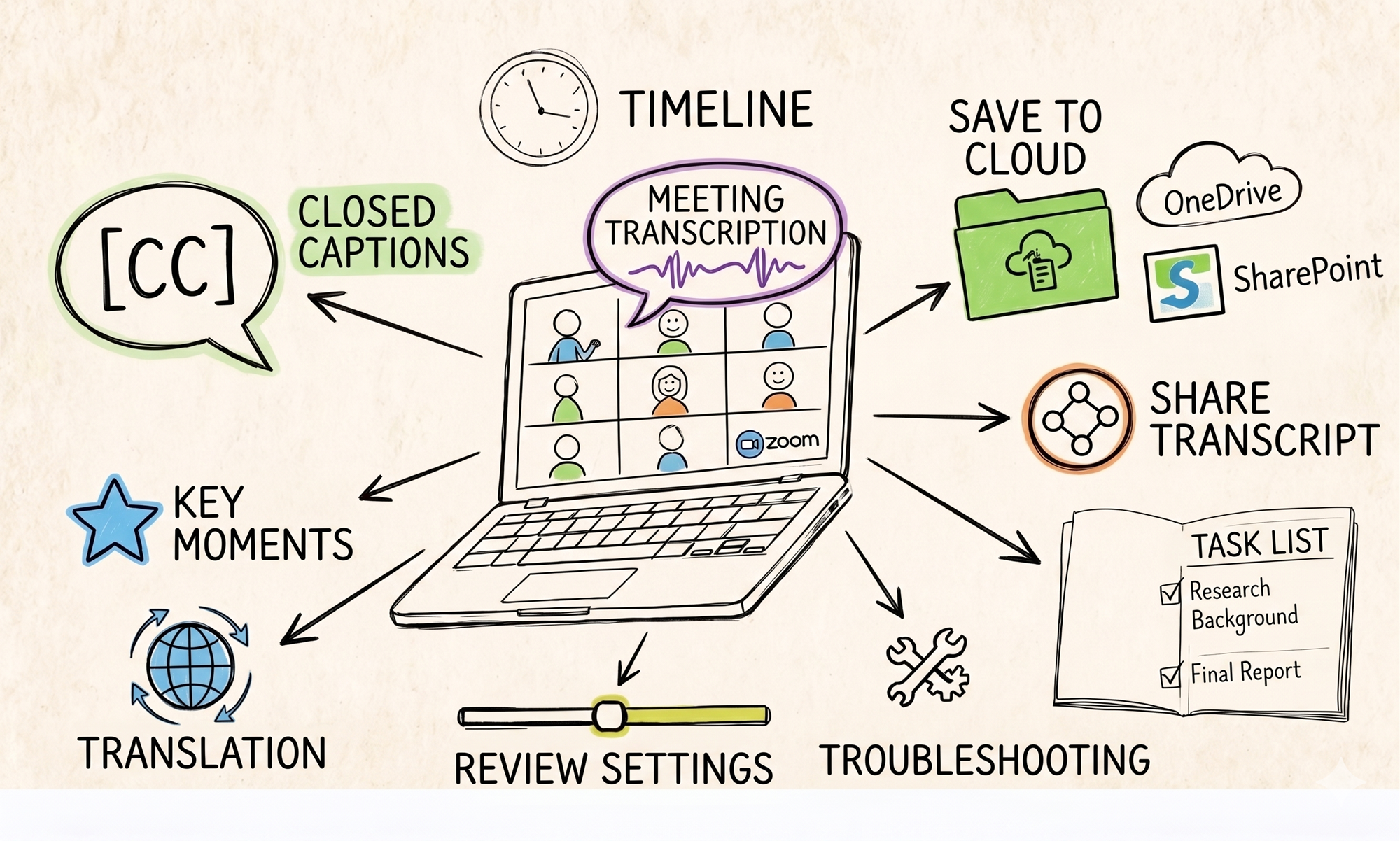
In our hybrid work world, recording virtual meetings is now completely standard. Platforms like Zoom, Google Meet, and Microsoft Teams have made it incredibly simple, and most even provide automatic notifications that a recording has started. For any business operating in North Carolina, these tools are perfectly fine to use under one-party consent.
The key is using them correctly. Announcing that you're recording at the beginning of a call isn't just a professional courtesy; it’s a smart practice for transparency, especially when people might be joining from states with tougher laws. For a deeper dive, check out our guide on how to record a Teams meeting for more detailed tips. Using a tool that automatically lets everyone know a recording is active helps you stay compliant without even thinking about it.
Ultimately, applying North Carolina recording laws comes down to a quick mental checklist. Am I a part of this conversation? Is there a reasonable expectation of privacy here? And are there any company or institutional policies I need to follow? Answering those three questions will give you the confidence to record legally and ethically.
Understanding Special Cases and Legal Exceptions
While North Carolina’s one-party consent rule is the main takeaway for most daily interactions, the law has some interesting corners and specific exceptions. These less common scenarios cover everything from preserving a piece of history on an old audio reel to holding police accountable during an interrogation. Digging into these outliers gives you a complete understanding of North Carolina's recording laws and the values they aim to protect.
One of the most unusual areas deals with how the state handles historical sound recordings. It’s a niche part of the law, but it’s incredibly important for archivists, historians, and researchers.
The Unique Rules for Pre-1972 Sound Recordings
Here’s a fascinating bit of legal history: before federal copyright law was updated in 1972, sound recordings existed in a kind of legal limbo. North Carolina decided to tackle this ambiguity head-on by creating its own set of rules. So, if you're working with very old audio—think historical speeches, interviews, or musical performances recorded before February 15, 1972—you're not looking at federal law. Instead, you'll be dealing with North Carolina's own statutes.
The key law here is N.C. Gen. Stat. § 14-433, which lays out the state's anti-piracy rules for sound recordings. But the really interesting part is the exceptions it carves out, which are a huge help for educational and archival work. It essentially creates a safe harbor for certain organizations to digitize and preserve historically significant audio without getting tangled up in anti-piracy laws.
North Carolina's approach to pre-1972 recordings is noteworthy because the state is one of the few with specific exemptions for nonprofit institutions and webcasters from the scope of its sound recording antipiracy statute.
Under N.C. Gen. Stat. § 14-433, the criminal statutes governing sound recordings don't consider consensual or noncommercial uses to be unlawful. This is a game-changer for universities, museums, and public archives sitting on priceless audio history trapped on deteriorating formats. To learn more, check out the great insights on historical recordings from Duke University's archives blog.
Mandated Recordings for Law Enforcement
Now, let's pivot to a completely different kind of exception—one that doesn't just allow recording but actually requires it. This area of law is all about police accountability and protecting individual rights during criminal investigations. North Carolina takes a firm stance here, mandating the documentation of certain high-stakes interactions between police and suspects.
Under N.C. Gen. Stat. § 15A-211, law enforcement agencies must make a complete audio and video recording of any custodial interrogation of a person suspected of a Class A, B1, or B2 felony, or any homicide. This isn't a suggestion; it's a legal requirement aimed at creating an objective, indisputable record of the interview.
The law is very specific about what’s required for these recordings:
- Completeness: The recording can't have any gaps. It must capture the entire interrogation from start to finish.
- Accuracy: It has to be a true and unaltered record of what was said and done.
- Documentation: Officers are required to document the circumstances of the recording and make sure it’s properly preserved as evidence.
This statute really drives home the state’s commitment to transparency in the justice system. An electronic record cuts through any "he said, she said" arguments about what happened in the interrogation room. It protects the suspect from potential coercion while also protecting officers from false accusations.
Penalties for Police Non-Compliance
To make sure this mandate has teeth, the state attaches serious consequences for non-compliance. If a law enforcement officer deliberately fails to record a required interrogation, it can cause major problems for the prosecution's case.
A judge can consider this failure when deciding whether any statements the suspect made are admissible in court. While a violation doesn't automatically get a confession thrown out, it gives the defense a very powerful argument to make. The court might even instruct the jury that they can take the lack of a recording into account when they weigh the evidence.
These rules for law enforcement reveal a different side of the North Carolina recording laws. They show that while individuals have rights under the one-party consent rule, the state also views recording as a critical tool for ensuring fairness and accountability in the most serious legal situations. It’s clear that audio and video documentation is seen as more than a personal right—it's a vital component of justice itself.
Your Step-by-Step Checklist for Lawful Recording
Knowing the rules is one thing, but actually putting them into practice is another challenge entirely. So, to help you record with confidence, here’s a practical, step-by-step checklist to mentally run through before you even think about hitting that record button. Think of it as building a safe habit that minimizes legal risks and keeps your recordings squarely within the bounds of North Carolina recording laws.
This decision tree infographic is a great visual for some of the special cases, like pre-1972 recordings and police interrogations, that fall outside the typical one-party consent framework.
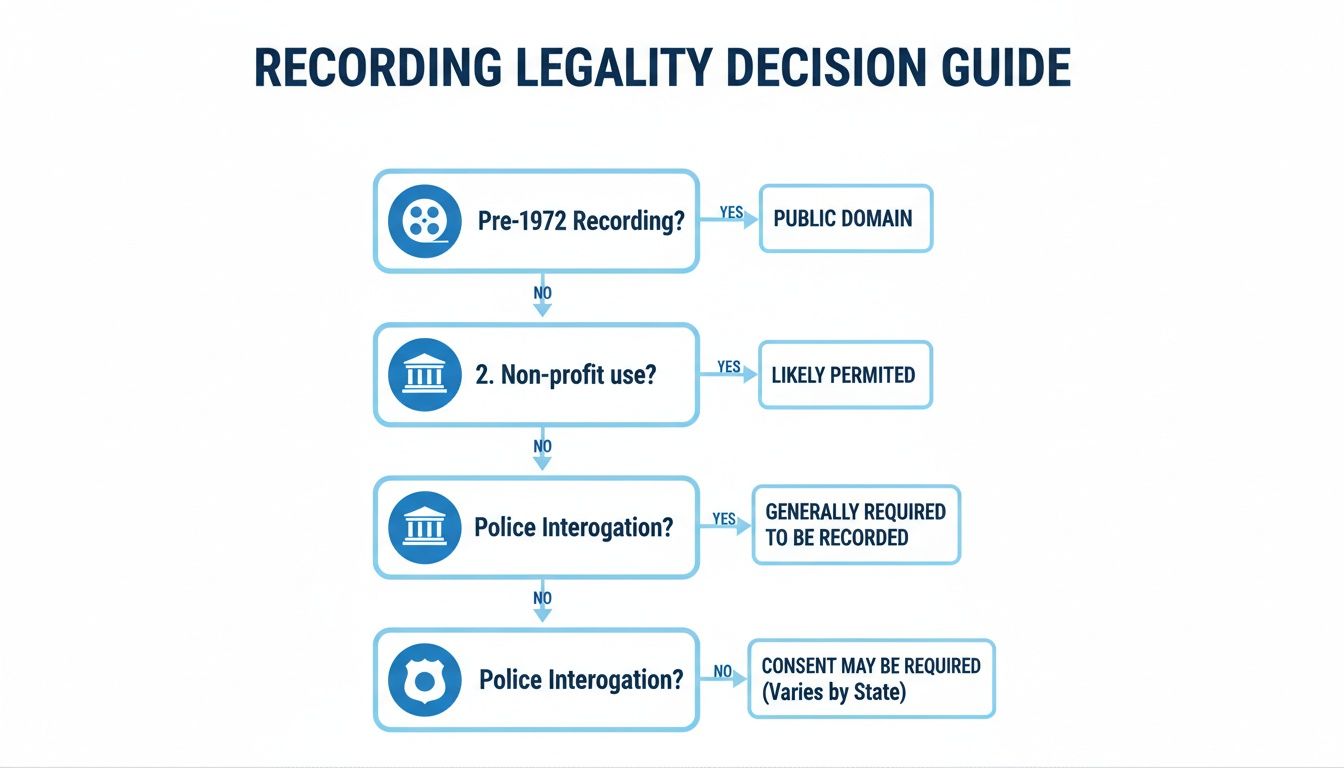
As the flowchart illustrates, specific situations—like how old a recording is or its use by certain organizations—can trigger different legal standards beyond the general rule.
1. Confirm You Are a Party to the Conversation
This is the absolute foundation of North Carolina’s one-party consent rule. Before you do anything else, simply ask yourself: "Am I an active participant in this discussion?" If the answer is yes, you've legally given your own consent.
Your participation is your permission slip. This holds true whether you're on a phone call, in a face-to-face meeting, or part of a virtual conference.
2. Evaluate the Expectation of Privacy
Next, take a moment to consider the setting. Is the conversation happening in a place where people would reasonably expect their discussion to be kept private?
- High Expectation: Think of a private office with the door shut, a doctor's appointment, or a sensitive heart-to-heart in someone's home.
- Low Expectation: Imagine a loud conversation in a public park, a chat in a bustling coffee shop, or a speaker at a public conference.
Recording in a place with no reasonable expectation of privacy is almost always a safer bet, as privacy laws often don't even apply in those scenarios.
3. Announce the Recording for Transparency
While it's not legally mandatory in North Carolina, I've seen firsthand how announcing that you're recording is both a professional courtesy and a smart legal safeguard. It removes any doubt and helps build trust right from the start.
A simple, non-confrontational phrase works best. Try something like, "For our notes, I'm going to start a recording of this call," or "To make sure I capture all the details, this meeting is being recorded."
This small gesture can head off misunderstandings down the road and is especially important when you’re dealing with people who might be in other states with different laws.
4. Handle Interstate Calls with Caution
If you're on a call with someone in an "all-party consent" state like California or Florida, you need to be extra careful. In my experience, the strictest law—which would be their all-party rule—will almost certainly apply. In these cases, always announce the recording and get a clear, verbal "yes" from every single person on the line.
For deep legal research and to double-check that your actions align with the latest rules, you might consider using advanced tools like AI legal software.
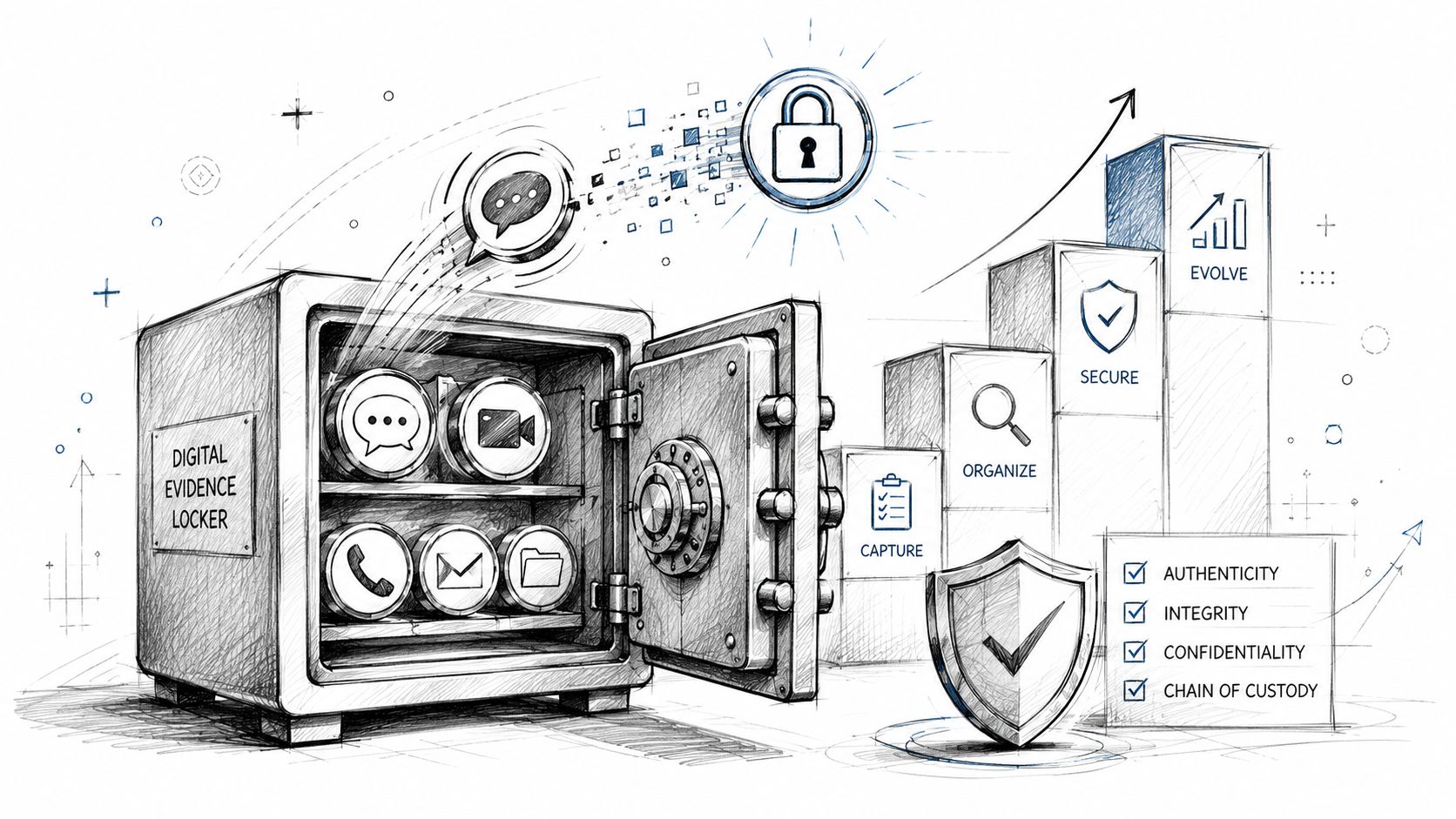
5. Store and Manage Recordings Securely
Finally, think about what happens after the recording is made. Even a legally obtained recording needs to be stored securely to protect the private information it might contain. If you're running a business, this is a non-negotiable part of data management and privacy compliance.
Using a secure platform to record and transcribe meetings can automate much of this process, making sure your recordings are not only useful but also protected. For instance, services like HypeScribe provide encrypted storage and put you in full control of your data, which is key to staying compliant from start to finish.
Your Top Questions About NC Recording Laws, Answered
When you get down to the brass tacks of North Carolina's recording laws, a lot of specific "what if" scenarios pop up. Let's walk through some of the most common questions people have when trying to apply these rules in the real world.
Can I Record Someone in an All-Party Consent State?
This is a huge one, especially with remote work and long-distance calls. Picture this: you're in North Carolina (a one-party state) and you need to record a call with someone in California (an all-party state). Whose law wins?
The golden rule here is to always follow the stricter law. To stay on the right side of the law, you absolutely must get consent from everyone on that call.
The easiest way to do this? Announce the recording right at the beginning and get a quick verbal "okay" from everyone. That simple step ensures you're covered, no matter where the participants are.
Can My Employer Record Me at Work?
In most cases, yes. North Carolina employers generally have the right to record conversations that happen on company property or using company equipment, like your work computer or office phone.
Think of it this way: when you're using company assets, your expectation of privacy is naturally lower. Most businesses will outline these monitoring policies in an employee handbook, which solidifies their right to do so.
But this isn't a free-for-all. That right to record stops at the door of highly personal spaces.
For example, it would be illegal for your boss to put a camera or microphone in a workplace bathroom or a locker room. These are places where everyone has a reasonable and absolute expectation of privacy, and recording there is a major violation.
Can I Use a Recording as Evidence in Court?
Absolutely. A recording you made legally can be a game-changer in a North Carolina courtroom, especially in civil matters. As long as you followed the one-party consent rule, your recording is typically considered lawful and can be presented as evidence.
That said, admissibility isn't a slam dunk. The final decision rests with the judge, who will look at things like the recording's relevance to the case and the context in which it was made before deciding if the jury can hear it.
Keeping track of legal recordings, particularly for business, demands the right tools. HypeScribe makes compliance straightforward by giving you a secure platform to capture, store, and manage your meeting recordings. It even includes features like automatic transcriptions and consent announcements to help you stay compliant.
Related reading