Is It Legal to Record a Conversation Without Consent? State Rules

So, can you legally record a conversation without the other person's permission? The only honest, legally sound answer is: it depends entirely on where you are. Think of it like driving across the country—the speed limit changes the moment you cross a state line. Recording laws work the same way, and misunderstanding the rules can lead to serious legal trouble.
This guide is based on my experience navigating these complex laws for business and personal use. We'll break down exactly what you need to know, from state-by-state rules to best practices for getting consent, so you can record confidently and legally.
Why Your Location Determines Everything for Recording Laws

Figuring out the rules for recording conversations feels a lot like learning local customs in a foreign country. What’s perfectly acceptable in one place could be a major offense in another. In the United States, the legal system is split into two distinct camps. Knowing which one you're in is the most critical step to staying on the right side of the law.
Before we dive in, getting a baseline by understanding general call recording features can be helpful.
The Two Types of Consent Laws
The entire legal framework comes down to one question: who needs to agree to be recorded? The answer creates two different legal standards that cover the country.
- One-Party Consent: In these states, you are legally allowed to record a conversation as long as you are part of that conversation. Your consent is enough.
- All-Party Consent (or Two-Party Consent): This is the stricter standard. Here, you must get permission from everyone involved in the conversation before you hit record. If there are ten people on a call, you need all ten to agree.
The biggest mistake I see people make is assuming that only their location matters. If you're in a one-party state but on a call with someone in an all-party state, their stricter law almost always takes precedence.
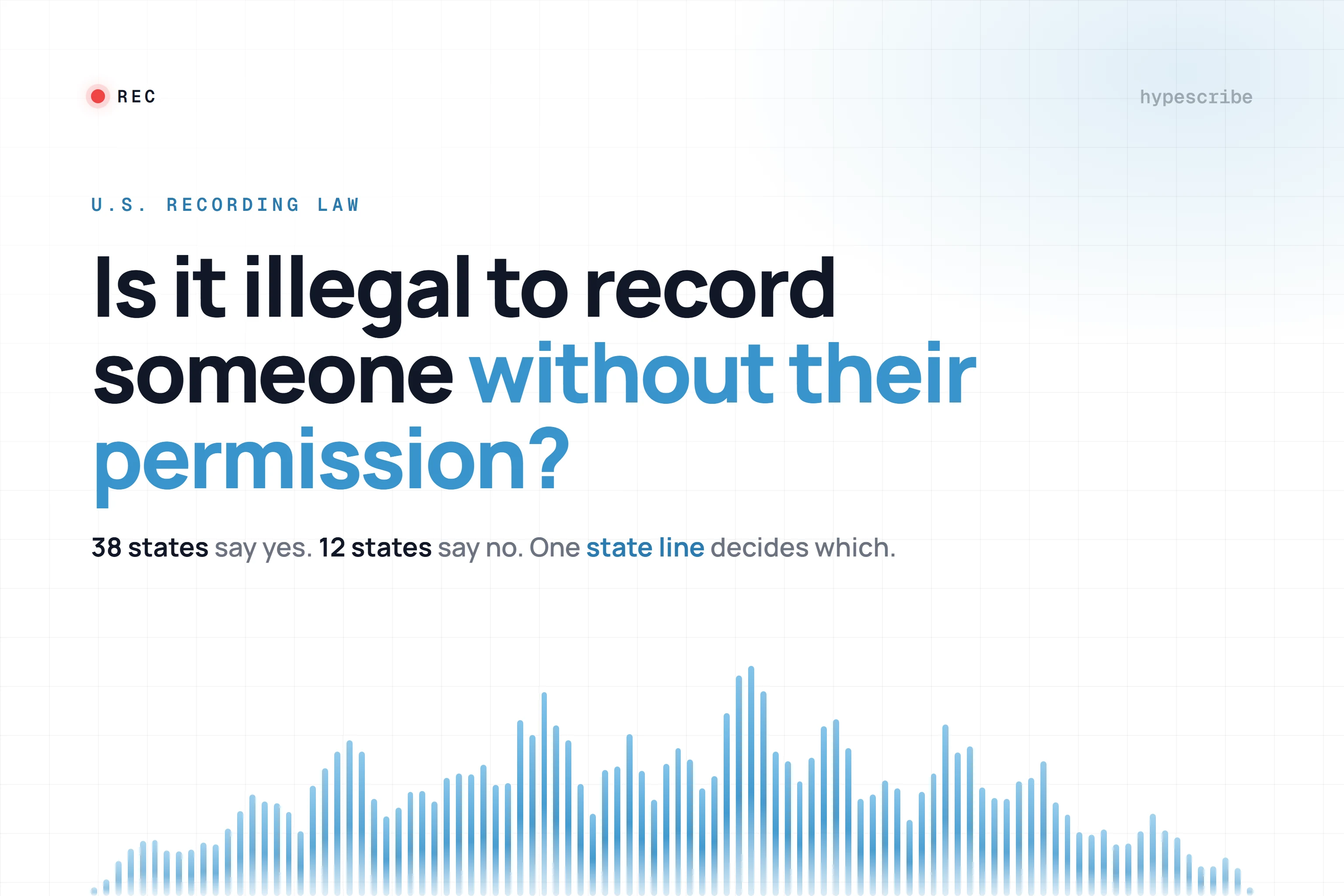
This patchwork of laws creates a tricky situation. Currently, 38 states and Washington D.C. follow the more lenient one-party consent rule, which aligns with federal law (the Electronic Communications Privacy Act).
However, a dozen states—including major business hubs like California and Florida—require all-party consent. And the penalties are severe. In Florida, for example, illegally recording a conversation can be a third-degree felony, potentially leading to up to 5 years in prison.
This is why you must always consider where every participant is located, not just your own location. Overlooking this detail is how most people get into legal trouble.
One-Party vs. All-Party Consent: At a Glance
To make this clearer, here’s a simple breakdown of the key differences between the two standards.
Ultimately, this table shows why the safest approach is always to act as if you're in an all-party consent state. It’s a simple rule of thumb that can keep you out of a world of trouble.
What Do "One-Party" and "Two-Party" Consent Really Mean?
So, what do these laws actually mean for you when you’re on the phone or in a meeting? The entire difference hinges on one simple question: who needs to agree to being recorded? The answer changes everything about what you must do before you hit the record button.
In a one-party consent state, the law is fairly straightforward. If you are part of the conversation, you have the right to record it. Your participation gives you the green light.
For example, a freelance consultant in Texas (a one-party state) can legally record a client call to ensure no project details are missed. They don't have to announce it because, as an active participant, the law grants them the right to keep that record.
How Is Two-Party (or All-Party) Consent Different?
Things get much more complex in two-party consent states. A more accurate name is all-party consent, because every single person in the conversation has to give permission. Here, privacy is a group agreement, not an individual choice.
Imagine you're in a sensitive business meeting in a state like Florida or California. If you were to secretly record that discussion, you would be violating a shared expectation of privacy that the law works hard to protect.
This is a huge distinction because it places all the responsibility on the person doing the recording. It’s not enough to just be there; you have to get explicit, documented consent from everyone involved.
Understanding the "Reasonable Expectation of Privacy"
Behind all these rules is a core legal idea: the reasonable expectation of privacy. This is the litmus test for whether consent laws even apply. The key question is: did the people speaking believe their conversation was private?
Let's look at two quick examples:
- Public Place: If you’re recording a keynote speaker at a crowded industry conference, you’re generally in the clear. The speaker is in a public forum and has no reasonable expectation that their words are private.
- Private Place: On the other hand, recording a one-on-one performance review in a manager’s closed office is completely different. Both people have a strong, reasonable expectation that the conversation is confidential.
Context is king. A conversation you can legally record on a public sidewalk might become an illegal recording if it happens behind a closed door, even with the exact same people.
This concept is a pillar of privacy rights. Navigating these consent frameworks requires a solid understanding of Data Privacy Law, which governs how personal data—including your voice—is collected, used, and protected.
How Remote Work Complicates Everything
The rise of remote work has thrown a major wrench into these rules. When your team is scattered across different states, a single Zoom call can cross multiple legal jurisdictions at once. This is a minefield where well-intentioned people often get into trouble.
Let's say you’re in Ohio (a one-party state) on a call with colleagues in Illinois and Maryland (both all-party states). Whose laws do you follow? The best and only safe advice from lawyers is to always follow the strictest law that applies.
In this example, you would absolutely need to get consent from everyone on the call to comply with Illinois and Maryland law. Your own state's more relaxed rule doesn't matter. Overlooking where other participants are located is one of the easiest and most expensive mistakes to make when asking if it is legal to record a conversation without consent. This "strictest law" principle is your only safe harbor when navigating interstate calls.
Navigating State-by-State and International Recording Rules
So you’ve got the basics of one-party versus all-party consent down. But the real challenge begins when you start dealing with people across state lines or international borders. In today's world of remote work and global teams, you need a practical guide to stay compliant, because the rules get tangled fast.
The legal landscape in the U.S. is a true patchwork. While most states are "one-party consent," a handful—11 to be exact—take a much stricter approach. If you're doing business across the country, it’s essential to know which states require everyone on the line to say "yes" before you hit record.
Which States Are All-Party Consent?
Here’s a quick reference list of the U.S. states where you'll need to get permission from every single person before recording. Think of these as the "ask everyone" zones.
This table breaks down the states that currently operate under all-party consent laws.
If anyone in your conversation is physically located in one of these states, the all-party rule kicks in for everyone. Memorizing this list is your first line of defense.
The Golden Rule: "Strictest Law Applies"
Here's the single most important rule for interstate conversations: the strictest law applies. It’s a common and dangerous mistake to assume that only the laws of your own state matter. That kind of thinking can get you into serious trouble.
Let's walk through a real-world example. Imagine you’re a project manager in Ohio, a one-party consent state. You have a critical video call with a major client who is in their office in California, an all-party consent state. Even though Ohio law lets you record without notice, California's stricter law wins because your client is there.
To be legally safe, you must get your client's permission before you record that call. It's not optional. When multiple states are involved, defaulting to the rules of the most restrictive one is the only safe way to do business.
This thought process is key to figuring out if it's legal to record a conversation without consent, depending on where everyone is.
This flowchart gives you a simple way to think about whether you have the right to record based on the setting.

The big takeaway here is that the "expectation of privacy" is always the first question you need to answer. Public places generally don't have that legal protection.
What About Global Recording Laws like GDPR?
The complexity doesn't stop at the U.S. border. When your calls go international, especially with people in Europe, you’re playing in an even tougher regulatory league. The main player you need to know is the General Data Protection Regulation (GDPR).
The EU's GDPR, which went into effect on May 25, 2018, completely changed the game for recording. It requires consent to be "freely given, specific, informed, and unambiguous." That means old tricks—like a quiet beep on the line or a buried clause in your terms of service—are no longer sufficient.
Under GDPR, an audio recording is considered personal data, and you need a clear legal reason to handle it. While consent is one of those reasons, you have to be able to prove it was explicitly given. For a deeper dive, you can find more details about international recording laws on Klenty.com.
This is a much higher standard than even the strictest laws in the U.S. For any business talking to European clients, the only safe path is to get clear, affirmative consent right at the start of every single recording. It doesn't matter if you need to properly record a Google Meet session or just a simple phone call; the rule is the same. Adopting a global best practice of asking for explicit consent will keep you compliant, no matter where your participants are dialing in from.
The Real-World Consequences of Recording Without Permission

It’s easy to read about recording laws and think of them as abstract rules. But getting it wrong isn't just a simple mistake; it's like stepping into a legal minefield. The consequences are real and go far beyond a slap on the wrist.
If you record a conversation without the right consent, you're looking at two major types of risk: criminal charges and civil lawsuits. Neither is a path you want to go down.
Criminal Penalties: Fines and Potential Jail Time
In states that demand all-party consent, hitting "record" without permission isn't a minor slip-up—it's often classified as a serious crime. In states like Florida and Pennsylvania, you could be looking at felony charges for recording a private conversation.
The penalties are no joke and can include:
- Heavy Fines: Financial penalties can run into thousands, or even tens of thousands of dollars, depending on the state and the severity of the violation.
- Prison Sentences: In the worst-case scenarios, a conviction could mean actual jail time. Florida's law, for example, makes unauthorized recording a third-degree felony, which can carry a sentence of up to five years in prison.
The simple act of recording a call at the wrong time could turn into a criminal offense in the eyes of the law.
Civil Lawsuits: The High Cost of Damages
Even if you avoid criminal charges, you’re not out of the woods. The person you recorded can still sue you in civil court for invasion of privacy. If they win, you could be on the hook for significant monetary damages covering everything from their emotional distress to financial losses.
The most overlooked risk of an illegal recording is that it's completely useless in court. The very evidence you thought would protect you is often the same evidence that gets thrown out, leaving you legally exposed.
Here's the real kicker: an illegally obtained recording is almost always inadmissible as evidence. That "smoking gun" you thought you captured is now legally worthless. Not only can you not use it to prove your point, but the act of creating it can open you up to a countersuit.
A Real-Life Example: The Recording That Backfired
Imagine a small business owner in a dispute with a client. Confident he was right, the owner secretly recorded a phone call where the client made key admissions. The business was in Texas (a one-party state), but the client was calling from California (an all-party state).
When the case went to court, the owner proudly presented his recording. The judge, however, immediately ruled it inadmissible because it violated California’s all-party consent law. Just like that, his most crucial piece of evidence was gone.
But it got worse. The client turned around and filed a separate civil lawsuit against the business for illegal recording. The owner, who thought he was protecting himself, ended up losing his original case and paying a hefty settlement for the privacy violation. This story is a sharp reminder that knowing whether it is legal to record a conversation without consent isn't just a technical detail—it's a critical part of managing your risk.
How to Get and Document Consent the Right Way

Knowing the law is one thing, but applying it correctly is what matters. The most crucial part isn't just knowing you need permission—it’s knowing how to get it and, just as importantly, how to prove you got it.
Building a compliant process means being upfront and transparent from the start. It’s about creating a system where asking for consent is a natural, clear step in every interaction you record. This doesn't just protect you legally; it builds trust. When clients and colleagues see you respect their privacy, it sets a professional tone.
Practical Methods for Gaining Consent
Getting consent doesn’t have to be awkward, but it must be clear. The method you use will depend on the situation, from a quick verbal heads-up to a formal clause in a contract.
Here are three solid ways to get the green light:
Clear Verbal Announcements: This is the go-to method for most calls and meetings. Before you start, simply state that the conversation is being recorded. A direct announcement like, "Just so everyone is aware, I'm recording this call for our records," is usually all you need.
Automated On-Screen Notifications: Modern meeting platforms make this incredibly simple. Tools like Zoom or Microsoft Teams automatically display a prominent visual alert and play an audio cue when a recording starts. This built-in function is a fantastic, automated way to disclose recording. Our guide on how to properly record a Teams meeting walks you through the steps.
Explicit Written Consent: For long-term business relationships, this is the gold standard. Add a recording consent clause directly into your service agreements, client contracts, or employee handbooks to establish permission from day one.
Simple Scripts You Can Use
How you ask for permission makes all the difference. You want it to feel like a routine part of your process, not a sudden demand.
For a Customer Support Call:
"Hi, thanks for calling [Company Name]. To help us improve our service, this call is being recorded. Is that okay with you?"
For a Sales or Client Onboarding Call:
"Before we dive in, I want to let you know that I'll be recording our meeting. This just helps me make sure I capture all the details accurately for you. Is everyone comfortable with that?"
For an Internal Team Meeting:
"Alright team, I'm going to hit record so we can share this with anyone who couldn't make it. Sound good to everyone?"
Each script is polite, direct, and gives a clear reason for the recording, making it easy for people to give informed consent.
Why You Must Document Consent
Getting a "yes" is only half the job. You must be able to prove you got it. If a dispute ever arises, the burden of proof is on you, the recorder. Without solid evidence of consent, your recording could be thrown out, and you could face penalties.
Your recording is only as legally strong as your proof of consent. Here’s how to create a reliable trail:
- Use Software Logs: Most video conferencing tools automatically log when a recording starts and which participants are present. These logs are impartial, time-stamped proof.
- Send a Follow-Up Email: After getting verbal consent, a quick follow-up email like, "As we discussed, our call today was recorded for our notes," creates a written paper trail.
- Record the Consent Itself: This is simple but powerful. When you announce that you're recording, that statement and the participants' verbal agreement (or their decision to continue the conversation) become the very first things on the recording, creating compelling evidence.
A Legal and Ethical Guide to Using AI Transcription
Knowing the law is one thing, but applying it to modern tools like an AI transcription assistant is another. These tools are incredibly efficient, but that power comes with responsibility. It's a mistake to treat them like simple tape recorders; they're sophisticated data processors, and you have to handle them with care to stay on the right side of legal and privacy lines.
The key is to build a workflow that treats these tools not just as a way to work faster, but as partners in creating secure, compliant records. This means you need to stop asking, "Can I legally record this?" and start asking, "How can we use this technology safely and ethically?"
Creating a Compliant AI Workflow
Putting a clear, step-by-step process in place is the only way to ensure you’re always on solid legal ground when using an AI assistant. This framework doesn't just protect your business—it builds trust by showing you're serious about privacy. Think of it as your pre-flight checklist for every recorded conversation.
Here are four essential steps to build into your routine:
Get Consent First. This is non-negotiable. Before you hit record or the AI starts transcribing, you must get explicit consent from every single person involved. Always default to the strictest standard (all-party consent). This has to happen before your AI assistant ever joins the call.
Announce the AI's Presence. Be upfront and specific. Say it out loud: "Just so everyone knows, we have an AI assistant on the line to transcribe our discussion." This provides clear notice.
Focus on Security Features. Use the security features of your tools. Ensure any transcripts and recordings are encrypted, both in transit and at rest. Tools like HypeScribe are built with these protections, but it's on you to make sure they're active.
Practice Data Minimization. Don't be a data hoarder. As soon as a recording or transcript has served its purpose, delete it securely. Keeping sensitive data forever is asking for trouble. Create a clear policy that dictates when and how this data gets permanently deleted.
A proactive approach to consent and security does more than just avoid legal trouble; it turns your use of AI into a sign of professionalism and respect for privacy.
Following a structured approach lets you get the most out of powerful AI-powered transcription software without stepping over any legal or ethical boundaries. It reframes the technology from a potential liability into a secure, compliant asset for your team.
Frequently Asked Questions About Recording Laws
Even when you think you've got the rules down, real-world situations can get tricky. Let's tackle some of the most common questions about recording conversations.
What If I Am in a One-Party State but the Other Person Is in a Two-Party State?
This is a classic "gotcha" in our remote-first world, and the answer is simple: the strictest law wins.
If you're in a one-party state like Texas but calling someone in a two-party state like California, you must get their permission. Courts almost always side with the law of the state where the person being recorded is located. The safest bet, always, is to get consent from everyone on the line if you're ever unsure about jurisdictions.
Does a Beep Tone at the Start of a Call Count As Consent?
Relying on a beep tone is a risky, old-school move. It used to be considered a form of implied notice, but legal standards have moved on, especially with modern privacy laws like GDPR demanding much more.
A simple, clear verbal announcement is your best defense. Saying, "Just to let you know, this call is being recorded," and waiting for them to continue the conversation, creates a much stronger legal foundation for consent.
The legal trend is clear: courts favor explicit, unambiguous permission. A beep can be missed or misinterpreted, but a direct verbal statement is hard to argue with.
Can I Record a Conversation I Am Not a Part Of?
This one is a hard no. Recording a conversation that you're not participating in is almost universally illegal.
This is considered eavesdropping or wiretapping, and it's prohibited by both federal and state laws. Doing this can land you in serious legal trouble with both criminal and civil penalties, regardless of the state's consent laws for participants.
What About Recording in a Public Place?
Generally, recording in public is fair game because there’s no "reasonable expectation of privacy." Think of someone giving a speech in a park or a loud argument on a busy street corner.
But context is everything. If you were to zoom in and record a whispered, private conversation between two people on that same park bench, you could be crossing a line. They might reasonably believe their conversation is private, even in a public setting. The "expectation of privacy" is always the deciding factor.
Ready to put this into practice and create compliant meeting records without the headache? HypeScribe offers secure, AI-powered transcription with features designed to support your consent process. Get accurate summaries and searchable notes while making privacy a priority.
Start your free trial today and see how simple compliant recording can be.